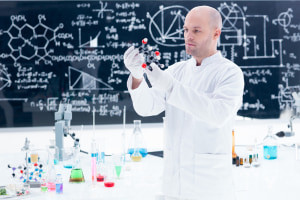
Organic substances and carbon are the foundation of all living things and the most abundant element in organic molecules. This course begins with an introduction to organic molecules and their carbon bonds. Then we look at different ways to represent organic compounds such as empirical molecular and structural formulas. You will learn how those three formulas are linked and what information they offer. Additionally we explain how to predict the number of double bonds for various compounds by applying the degree of unsaturation formula.After that we discuss the 2D representation of organic compounds including the displayed and skeletal formulas which use lines between atoms to draw bonds. We then describe the 3D displays of the structural formula ball-and-stick and space-filling diagrams. Following that you'll learn about functional groups like alcohols (-OH) and ketones (C=O) and how to name organic compounds based on the stem used in alkane naming.The course continues by explaining three types of structural isomers: position isomers functional group isomers and chain isomers each with specific properties. Next we discuss the two types of stereoisomers: geometrical (cis and trans) and optical isomers. After that we explore the organic reaction mechanisms and the homolytic and heterolytic fission. The study then shifts to electrophiles electron-deficient species and nucleophiles electron-rich species. The six different types of organic reactions: addition elimination substitution hydrolysis oxidation and reduction along with their characteristics will be covered in the final section. Sign up right away to begin studying organic chemistry.
Intermediate Chemistry: Introduction to Organic Chemistry
Intermediate Chemistry: Introduction to Organic Chemistry
Sold by:
Similar Products