The basic concepts of electricity dating back over two thousand years were unveiled by early scientists. Over the years scientists have unlocked the nifty mystery of electricity by studying and analysing the concepts of electricity using various scientific procedures or methods. Electricity has contributed immensely to the birth of civilization. Electrical energy is a common form of energy found in large amounts in power stations and small quantities in consumer devices like the calculator. Every home-based electronic device uses the basic concept of electricity in direct current (DC) which is essentially the movement of electrons through conductive materials. This course explores the fundamentals of a DC circuit. Discover the laws and theorems applied in DC circuits formulated by early scientists. Upon that we will introduce you to the nature of electricity and go through relevant electrical equations.Conductors in simple terms are materials (usually metals) that allow the free flow of electrons through them. However several conductive materials differ in nature which consequently affects the rate at which they allow electrons to flow through them. In this course you will investigate several conductive materials including those suitable in today’s application of electricity. As there are materials that allow the free flow of electrons through them there are also materials that do not allow the free flow of electrons. Such materials are known as insulators. You will learn about insulators and why they do not allow the free passage of electrons through them. We will study Ohm’s law and how you can use it to calculate components such as current voltages and resistors across a circuit. In addition you will gain an understanding of the arrangements of resistors (materials that allow a certain amount of electric charge to pass through them) across a circuit and determine the total. We will also introduce you to circuit theorems such as Norton’s theorem and Thevenin’s theorem and the analytic method used to analyse several DC circuits.The capacitor is an electrical component that stores energy in an electric field. Why does a capacitor store energy and not charge? You'll uncover the reason and how to arrange capacitors across a circuit. Conversely magnets are materials that generate a magnetic field. Though invisible they have forces that can attract ferromagnetic materials. However the phenomenon associated with magnetic fields that arise from the motion of electric charges is known as 'magnetism'. This course will examine magnetism including various equations used to calculate electromagnetism in DC circuits to determine factors such as magnetic flux reluctance and permeability of a material. Furthermore we will introduce you to Faraday’s law of induction and inductance. An understanding of basic mathematics and linear equations is required to take the course. It is for learners willing to understand the basic concepts of DC circuits of electricity. If you are curious and fascinated with the power of electricity don’t hesitate: enrol and start this course today.
Basics of Electricity and DC Circuit Analysis
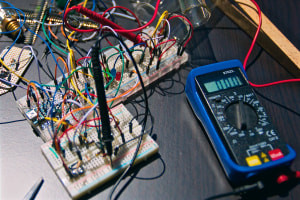
Basics of Electricity and DC Circuit Analysis
Sold by:
Similar Products